At its height the cotton industry involved a significant proportion of the world's population in growing, shipping, spinning, weaving, bleaching and dyeing cotton. In Lancashire the import of raw cotton reached a record 2,132 million lbs in the period 1912-14, an almost five-fold increase on the 1839-41 figure of 452 million lbs.
Almost 80% of the cotton industries workforce in this country were concentrated in Lancashire by the end of the 19th century. The 1911 census records almost half a million people in Lancashire employed in cotton production.
Cotton exports were vital to Britain's economy. In 1839-41 exports stood at 452 million pounds of yarn and cloth. By 1912-14 this had risen to 1,444 million lbs, and this despite high tariff barriers in Europe and the USA. By this time India had emerged as an important market and was taking over a quarter of cotton piece goods exports.
1920 started off as a boom year, with mills changing hands at enormous prices. The euphoria soon evaporated. By August, thirteen Blackburn mills on the Indian trade were stopped. At Christmas, the number increased to 34. In 1921, the Government of India placed an 11 per cent duty on goods entering that country. This had not been opposed by the British Government, despite protests from the Weavers, and a deputation of local M.P.’s.
The Blackburn Chamber of Commerce passed a resolution in February, 1921: "That this Chamber views with alarm the total disregard shown by H. M. Government to the justifiable interests of the cotton trade of this country." The number of mills stopped for lack of orders stayed at 34, but in 1922, when the Indian duties were raised to 14 per cent, this increased to 47, 43,000 looms were idle. In the next few years, numbers of textile firms became insolvent, and the mills closed had no hope of re-opening. There were no bids for mills which came onto the market.
As a relief measure, the Town Council started a series of road works, constructed tennis courts in Corporation Park, and designed and built a by-pass road round the edge of town, from Yew Tree to Whitebirk which opened in September 1928. Unemployed cotton workers were used on all these schemes. By March 1928, there were 6,000 unemployed, more than half of them weavers normally working on the Indian trade.
The cotton industry was analysed in detail in such articles as "Is Lancashire finished?". These showed that Japan had taken away much of our eastern trade, while the industry itself was changing, with knitted fabrics replacing woven ones for a number of uses, such as underclothing, nightdresses, and linings for suits. Leisure garments and cardigans were also of knitted construction. Finally, simplified garments and shorter skirts for women had reduced the amount of cloth needed, and this was not compensated for by uses for textiles in aeroplanes, car tyres, and boot and shoe linings. Rayon was very popular, but had not been used for the Indian market.
Unemployment reached 59 per cent in Blackburn in Spring, 1930. In an effort to stimulate the sale of cotton, a Cotton Week was organised in June 1930 at the Public Halls, with an exhibition of different fabrics, a cotton ball, and a cotton shopping week.
Because of the high level of unemployment among school leavers, special Junior Instruction Centres were set up at Maudsley Street and Audley Range Schools. Classes were started in dressmaking and cookery for the girls at Audley Range, and drawing, woodwork and metalwork for the boys. Both boys and girls were also encouraged to take part in singing and physical training.
To reduce the costs in the mills which remained, a new system of weaving was tried in 1919/30 which enabled weavers to watch up to 8 looms, being given help in non-weaving duties. This was opposed by the Weavers, as it threatened to reduce the number of jobs at a time of high unemployment. The result was a lock-out, which ended on February 14, 1931.
There was a sharp financial crisis later in the year, which brought in a National Government, and increased unemployment in Blackburn to 24,000. There were 1,000 empty houses and 166 empty shops - Blackburn was starting to lose her population. The slump continued, being intensified in Blackburn by a further increase in Indian duties. The Lancashire Cotton Corporation, which had been formed in 1929, started to acquire mills in Blackburn, in most cases closing them down and scrapping the machinery. The Government felt that much of the lost trade would never be regained, so encouraged the formation of the Cotton Corporation, which was given the task of buying up cotton mills, retaining the ones which were efficiently run or could be modernised, and scrapping the machinery in the rest.
As the 8-loom system was not working, employers started to cut wages in an endeavour to bring down costs. The Textile Federation, representing the weavers, gave notice of strike against the cuts, from August 27, 1932. The dispute was settled on September 24, but wage cuts were restarted at some mills soon afterwards.
For the youngsters who did enter the industry there were improved training methods and welfare facilities. Canteens had been introduced during the war, and these paved the way for rest-rooms, sick bays with trained nursing staff and day nurseries to attract young adults into the mills. The number of non-English speaking recruits, and the difficulty in communication over the noise of the machinery led to the establishment of training schools away from the shed, and scientific training. Each process was explained to the trainees, who then carried out the movement on a loom.
Another post-war development was social clubs for the younger members of some of the larger firms. These were promoted by the personnel department and were designed to encourage an identity with the firm, and also help youngsters who might have to move to another mill in the group, so that they would know some of the workers at the new site.
The industry was experiencing a boom. Someone thought up the slogan “Britain's bread hangs by Lancashire's Thread" exhorting weavers to do their utmost to increase production. Conditions were now right for the introduction of new machinery. An automatic loom which enabled a weaver to take charge of 20 to 25 looms had been developed in the late 19th Century, and built in Blackburn since 1903. The machines had not been considered a success when tried out in Blackburn. Also most large weaving sheds had installed new looms in the 1890s, so were not ready to re-equip when the new looms appeared.
Between the wars with a falling demand for Lancashire cloth, and many unemployed weavers, was largely a time of loom scrapping. Now, with sales increasing and a shortage of weavers, conditions were right for automatic looms, and large numbers were installed between 1948 and 1950. Often a loom shed had to be rebuilt to fit the looms, as they were much wider than Lancashire looms, and the pillars supporting the roof were spaced wrongly. New building techniques enabled the number of pillars to be greatly reduced, producing a much more open plan.
back to top
By Richard Holden
Introduction
An industrial dispute, akin in ferocity and bitterness to the Miners’ Strike forty years later, unfolded between 1930 and 1932 in Lancashire weaving towns. A profile of the dispute in Blackburn highlights both the challenges facing the industry at this time and the demise of a once highly regarded ‘model’ of industrial relations. The dispute centred on what became known as ‘more-loom working’. Traditionally weavers operated four looms. More-loom working meant that one operative would control six or eight looms.
Backs to the wall
Both employers and unions faced tough times in the 1920s and early 1930s. The cotton industry was in decline. Exports of cotton piece goods fell by nearly 50% between 1924 and 1934. The decline in the Indian market particularly affected Blackburn. In the same period over 30 of Blackburn's 100+ mills closed. Unemployment in Blackburn reached a staggering 52% in June 1930; with short-time working and under-employment on top of this. There was a further ironic twist. Blackburn Technical College had a world-wide reputation for high quality textile courses and the inter-war years saw an increasing number of overseas students who would return to their home country to work on looms from closed East Lancashire mills. Wage cuts had been the 'go to' strategy of the employers once the post-war boom began to fade. In the late summer of 1929, an ongoing wage dispute went to arbitration and resulted in the Rigby-Swift Award (effectively a reduction in wage rates of over 6%). Far from settling matters, given that it involved a reduction in pay, the award only served to increase weaver resentment and protest.
More-loom working
Steadily worsening trading conditions (protectionist measures by the US, India and Japan increased substantially in 1930, ’31 and ’32) were forcing new thinking on productivity measures. More-loom working fell into this category. Experiments on eight-loom working in a small number of Burnley mills had begun in 1928 and most employers across the county were hopeful of an agreed roll-out in due course. The principal union representing weavers in Blackburn was the Blackburn & District Weavers Winders and Warpers Association.
The Blackburn & District Weavers Winders and Warpers Association Banner
Blackburn Museum & Art Gallery
Whilst there were sceptics within the union – would more-loom working be possible for Blackburn cloth ? – nonetheless the system of industrial relations was such that local employer associations and weaver unions deferred to their county level negotiation bodies (the Cotton Spinners and Manufacturers Association and the Northern Counties Textile Trades Federation). A majority view within the NCTTF shared the view of the employers that an eventual county wide agreement on more-loom working was both desirable and achievable. However, hopes of a quick negotiated settlement on more-loom working proved groundless. Whilst the experiments, generally speaking, demonstrated that eight-loom working was possible the stumbling block was the revised Uniform List (the rates of pay for a length of woven cloth) that would apply. Positions began to harden. The employers were convinced that more-loom working would bring about enhanced productivity. The unions - reflecting a greater hostility to more-loom working on behalf of the membership – were adamant that associated wage increases did not reflect the additional effort required to operate more looms. An additional concern was the impact on labour displacement. Towards the end of 1930 the CSMA took the decision to force the issue by instigating a lockout. The B&DWWWA issued a statement noting their “uncompromising opposition” (Lancashire Evening Post, 11 December) to the employers’ action. Virtually all Blackburn mills closed. The lockout lasted four weeks but with strong union opposition and evident weaknesses in the employers camp it was ended in mid-February. Whilst hailed as a union victory no fundamental resolution to the dispute was in sight. The Lancashire Evening Post (19 March) reported that there was a general resumption of work in those Blackburn mills that had been working immediately prior to the lockout. But trading conditions meant that few Blackburn mills were running at full capacity. Importantly, strains were becoming evident within the industrial relations framework. By the middle of 1931 employers disaffected by the inconclusive policies of their associations, began to propose single mill (‘breakaway’) agreements for both wage rates and more-loom working. Initially these were outside Blackburn, for example in Burnley and Nelson. The first move in Blackburn was taken by Dewhirst St Mill in September, where an experiment in more-loom working was introduced. It was followed by similar moves at Eclipse Mill, Grange Mill, Wensley Fold Mill, Patterson St Mill and Victoria Mill.
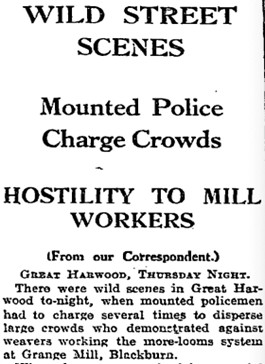
Manchester Guardian, January 15Such proposals met mixed receptions; from both the mill weavers themselves and the B&DWWWA. A principal concern of the union was labour displacement. Despite protestations from the B&DWWA (18 December) that “we accept no settlement unless all operatives are working” such calls often fell on deaf ears; more-loom working proposals proceeding with or without union agreement. The union were also fearful of disintegration amongst an already dwindling membership. Tensions spilled over into violence in January 1932 when attempts to move to six-loom working at Grange Mill provoked demonstrations from other Blackburn weavers culminating in disorder and arrests.
Blackburn: centre of the wage reduction movement
Breakaway agreements (on pay, on more-loom working and often on both) increased significantly in 1932. The Manchester Guardian (24 June) gave Blackburn the dubious accolade of “the centre of the wage-reduction movement”. A degree of chaos prevailed. Whilst weavers at one mill would successfully resist attempts to reduce wages a nearby mill would agree. On April 29, for example, it was reported that Gorse Bridge Mill had unanimously decided to call a strike in protest against a proposed wage cut. However, on very same day, at nearby Prospect Mill, only about 30 weavers of 250 obeyed a union instruction to stay away from work. B&DWWWA minutes (22 March) report weavers at Victoria Mill voting against a reduction in wages only for the decision to be reversed the following day. B&DWWWA tactics to focus union attention on a handful of mills making proposals for wage and/or more loom working proved largely ineffective. Local trade union officials were between a ‘rock and a hard place’, trying to follow policy issued from the county central committee whilst facing an increasingly fractious local membership. One local Blackburn official reported back to his committee: “The operatives have decided to give it (more-loom working) a trial. They feel the proposals are better than unemployment pay, and circumstances have compelled them to accept” (Blackburn Textile Trades Federation, 8 April).
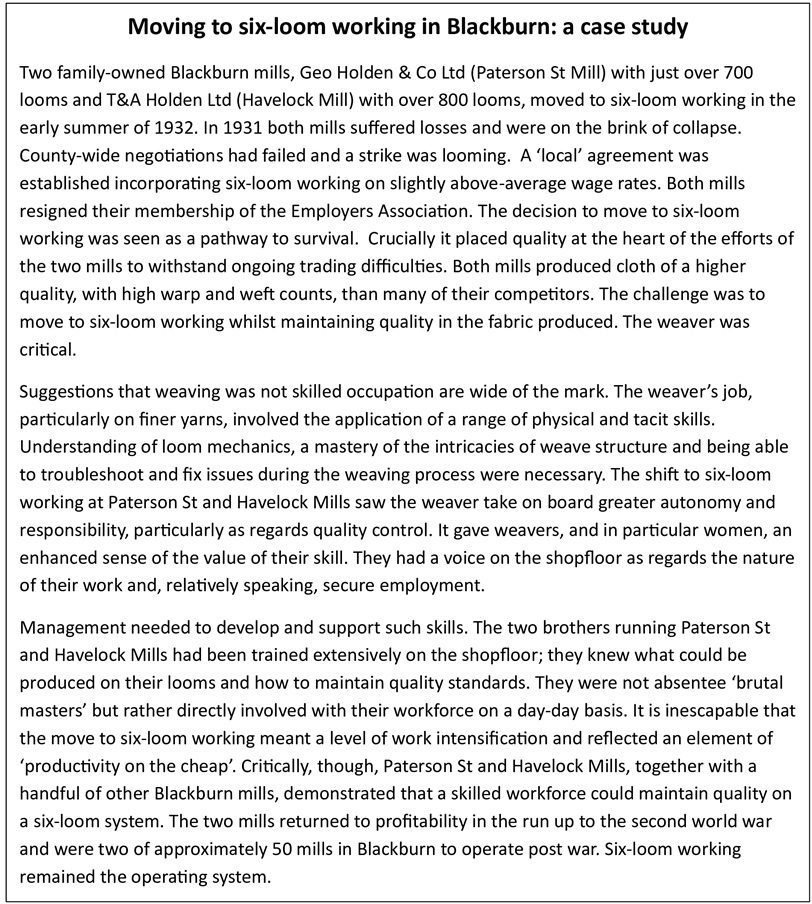
Source: Holden, T, 2001, Boom & Bust in Cotton Manufacturing. Holden, R and Hall, R, 2025,
Moving to More-Loom Working in the Blackburn Weaving Industry: A case Study, North West History Journal
Even at county level one senior NCTTF official, commenting upon the confusions, contradictions and overall difficulties facing the union, said: "at present trade union officials are like sanitary officers trying to combat a spread of disease!” (Manchester Guardian, 19 April). The language used by both groups reflected the rising levels of tension. Employers attempting to introduce new terms and conditions were labelled ‘brutal masters’ and workers defying union efforts to dissuade them agreeing to wage cuts and/or more-loom working ‘knobstick weavers’. Indeed, the availability of labour as a result of high levels of unemployment meant that some mill owners were happy to import ‘blackleg labour’. Not unsurprisingly this led to local disturbances. A former Blackburn weaver recalls an incident at a neighbouring mill which had resorted to using ‘blackleg’ workers.
Towards strike action
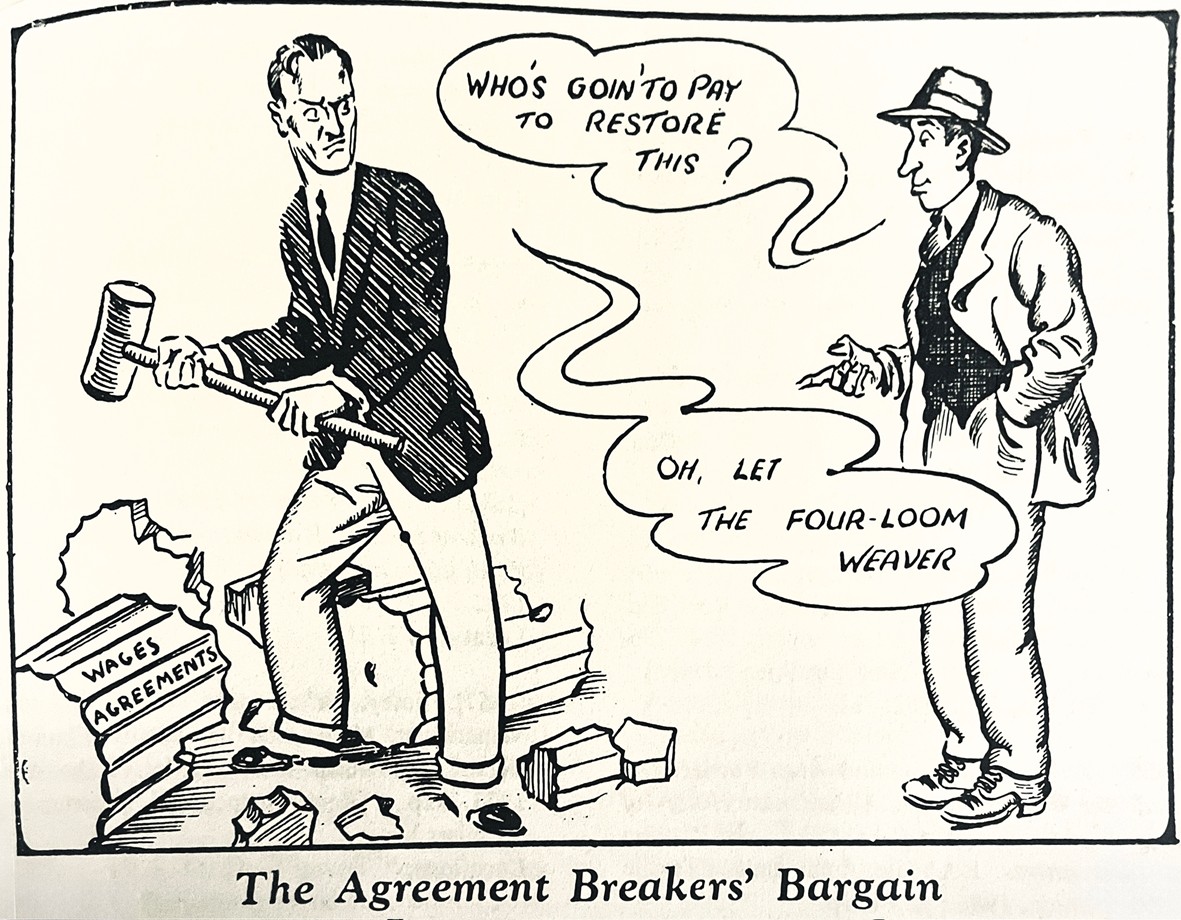
The prospect of a rising tide of breakaway agreements had seen both employers and unions return to negotiations over more-loom working in the latter half of 1931. A degree of consensus had always existed on the principle of six-loom working. However, negotiations on the associated Uniform List were deadlocked. This reflected the inherent complexity of the weaving process across the county; cloth types, speed of looms, looms with automatic attachments etc. In April 1932, following the refusal of the trade unions to re-enter negotiations around renewed attempts to cut Uniform List prices (itself a highly contested decision) the employers responded with the threat of abrogation; the ending of all joint agreements. This duly transpired in June. Employer Association members were now free to pursue individual mill agreements. The cartoon (see Figure) in the Worrall Textile Trade Directory reflected wider uncertainty as to the wisdom of such a decision. The unions responded with discussions on a possible county-wide strike. A ballot was held and whilst a majority voted in favour of strike action a substantial minority favoured continuing negotiations.
The Lancashire Textile Industry, 1932, Worrall
There were stark differences in voting patterns across the county. Figures for Blackburn showed 8410 voting for strike action whilst 6150 voted for continuing negotiations (B&DWWWA, 22 June). In contrast the corresponding figures for Burnley were 12026 and 3512. Blackburn local officials were nervous as to the likely efficacy of the strike. The chaotic profile of industrial relations before and immediately after the strike ballot, together with continued high levels of unemployment, had created a level of demoralisation amongst the weaving workforce in Blackburn.
Mill
| No. of looms |
Wensley Fold/Grange*
| 1571 |
| Garden St/River St | 1376
|
| Shakespeare | 1212 |
Newton St/Walpole St
| 1100
|
Parkside*
| 880
|
Prospect
| 880
|
| Havelok* | 842
|
Fountain
| 800 |
Large Blackburn mills with new arrangements (*more loom working)
This appeared to preclude a successful stoppage. Following abrogation breakaway arrangements had proceeded apace (sometimes with workforce agreement; at other times simply enforced by the employer). By the time of the strike ballot over 40 Blackburn mills were operating outside of the Uniform List; some on six-loom working, but mostly simply on a reduced wage basis (see Table). Whilst the central narrative at county level was more-loom working, at local level it was more a scramble by employers to reduce costs in the quickest and simplest way possible and this meant wage reductions.
The ballot had failed to provide the required majority for strike action; a final decision reverting back to the NCTTF council. The NCTTF, with some hesitancy, called for strike action to begin on 27 August. Reliable figures on the level of the support for the strike are difficult to establish. The B&DWWWA expressed satisfaction with the response (Lancashire Evening Post, 29 August) though several mills on more-loom agreements did not stop. Somewhat surprisingly given the level of social unrest evident in the months leading up to the strike it appears to have passed off relatively peacefully. The Lancashire Evening Post (29 August) reporting on the first day of the strike noted that whilst picketing was widespread it rarely resulted in any violence or arrests. Indeed, they note instances of good humour between workers walking through picket lines. As a group of young girls approached one mill a wag in the crowd shouted “Let ‘em in, they want a bit of something for lipstick”. At another, where a group of pressmen were entering the factory gates, one wit is reported as shouting “how many looms do you want ?”.
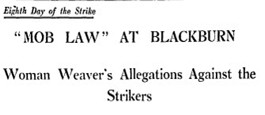
There were exceptions. Operatives leaving Swallow Street Mill were booed by a large crowd outside the mill and it was only “with difficulty that the police, some of whom had been conveyed into the mill in an ambulance, kept the crowd clear of the exiting workforce” (Manchester Guardian, 31 August). The same paper ran a story on 6 September proclaiming “Mob Law at Blackburn”.
Manchester Guardian, 6 September
A letter from a woman weaver to the Blackburn & District Cotton Manufacturers Association alleged “brutal treatment” by strikers. The woman contended that in the scramble to enter the mill through the picket line her friend had been pushed down and that when she bent down to help her up was struck on the back of the head with a piece of wood. Interestingly, the secretary of the B&DWWWA blamed communist agents for a number of isolated instances that he acknowledged had had taken place in the early days of the strike.
The end of the dispute ?
The strike lasted until late September. A significant intervention by Government brought the two sides back to the negotiating table and after a series of joint meetings at the Midland Hotel, Manchester, the first “More Looms” agreement was signed. Six-loom working was to be the main system of operating on a new price list. Whilst weavers would receive an increase in ‘take home’ pay in the region of 20% they would be operating 50% more looms. Importantly, the Agreement included a commitment to restore the collective bargaining system that operated pre-dispute. Sadly, the agreement proved to be no panacea. Its adoption was limited. The Blackburn Textile Trades Federation reported towards the end of 1933 that many of the ‘breakaway agreements’ established In Blackburn in 1932 had not been revised in line with the Midland Agreement (Manchester Guardian, 2 November). A number continued with four-loom working, often on the Midland Agreement rates of pay for six-loom working (effectively a reduction in relative pay rates beyond that of the Agreement). The result was that individual mills were pitted against each other in competition for a declining market. And all the time mill closures continued.
The Midland Agreement, whilst hailed at the time as a progressive ‘compromise’, only really patched over the cracks. Industrial relations continued to be chaotic. There would be no return to the much-admired system that was decimated as a result of the more-looms dispute. Interestingly, the Secretary of the B&DWWW, and with the support of a number of leading employers, issued a call in 1933 for a Control Board with the power to issue licences. These would be issued only to firms complying with the county agreements, rekindling hopes that a return to some kind of ‘order’ to relations between cotton manufacturers and unions could be restored. It was not to be. Neither employer or union could resist the inexorable forces of globalisation and technological change. Importantly, the loss of any system or vehicle to ‘jointly’ address the challenges would be sorely missed.
The protracted more-looms dispute took its toll – not least in Blackburn, more vulnerable than many other Lancashire towns to the competition for ‘plain cloth’ from overseas. For the town as a whole the unrest and conflict, particularly in 1932, had reached into all corners of the community. Whilst there were ‘survivors’ - those working in more-loom mills competing on quality cloth - for a greater number the conclusion of the dispute only spelt an uncertain and often bleak future. Between 1933 and the start of the second world war a further 30 Blackburn mills closed; amounting to over 21,000 looms.
Acknowledgement
With thanks to staff at Blackburn with Darwen Community History Library, the Lancashire Archives and the Working Class Library, Salford for searching out and retrieving relevant archival and newspaper sources.
Richard Holden, published February 2026